Introduction: The Greensward Masterpiece of Manhattan
In the vibrant heart of the world’s densest urban grid lies an 843-acre emerald oasis that has captured the imagination of travelers, poets, and filmmakers for nearly two centuries: Central Park. Stretching two and a half miles from 59th Street (Central Park South) to 110th Street (Central Park North), and half a mile across from Fifth Avenue to Central Park West, this monumental sanctuary receives over 42 million visitors each year. Yet contrary to common belief, Central Park is not an untouched remnant of wild Manhattan nature. Every hillock, serpentine pathway, water body, and pastoral meadow is a masterpiece of deliberate, visionary landscape engineering designed by visionary architects Frederick Law Olmsted and Calvert Vaux in their historic 1858 ‘Greensward Plan’.
To truly appreciate Central Park requires moving beyond casual perimeter strolls. The park contains more than thirty historic bridges and arches—each uniquely constructed from Manhattan schist, Ohio sandstone, or ornate cast iron—along with formal European gardens, cascading waterfalls, a miniature Scottish castle, and tranquil lakes where wooden rowboats glide across mirrored waters. However, walking the entirety of the park’s 58 miles of pedestrian trails on foot can be physically exhausting, especially during humid summer afternoons or chilly autumn breezes. An expertly coordinated private chauffeured excursion with Tour to NYC Central Park Sightseeing pairs strategic perimeter chauffeur staging with guided walking loops, allowing travelers to experience the park’s crowning monuments in effortless comfort without fatigue.
In this comprehensive architectural and historic deep-dive, we explore Central Park’s geographic zones, reveal the forgotten history of Seneca Village, uncover hidden botanical treasures, and provide insider tips for experiencing the park’s most breathtaking vantage points.
The Southern Park: Victorian Elegance & Architectural Splendor
1. The Grand Army Plaza & The Pond
The southern threshold of Central Park at Fifth Avenue and 59th Street is framed by Grand Army Plaza, presided over by Augustus Saint-Gaudens’ gilded equestrian monument of General William Tecumseh Sherman and Karl Bitter’s bronze Pulitzer Fountain. Stepping into the park, visitors descend toward The Pond, a tranquil, winding body of water crossed by the picturesque Gapstow Bridge. Constructed of rough-hewn Manhattan schist in 1896, Gapstow Bridge offers one of the most iconic photographic vistas in the city, framing the peaceful pond waters against the towering silhouette of the historic Plaza Hotel and modern supertalls along Central Park South.
2. The Mall and Literary Walk: The American Elm Cathedral
Continuing northward, visitors enter The Mall, the only formal straight walkway in Olmsted and Vaux’s design. Flanked by four magnificent rows of American Elm trees (Ulmus americana), the Mall forms a soaring living cathedral canopy that turns into a breathtaking vault of pure gold in late October. The southern end of the Mall, known as Literary Walk, features bronze statues of literary giants, including William Shakespeare, Robert Burns, and Sir Walter Scott. In 2020, the historic Women’s Rights Pioneers Monument—depicting Sojourner Truth, Susan B. Anthony, and Elizabeth Cady Stanton—was dedicated here, marking the first statue in the park depicting real historical women.
3. Bethesda Terrace and Fountain: The Heart of Central Park
At the northern terminus of the Mall lies Bethesda Terrace, universally acclaimed as the architectural and emotional heart of Central Park. Constructed on two levels connected by sweeping sandstone staircases carved with intricate depictions of the four seasons and nature, the terrace features an extraordinary covered arcade ceiling adorned with 15,614 patterned encaustic tiles manufactured by the historic Minton Tile Company of Stoke-on-Trent, England. Emerging onto the lower plaza, visitors are greeted by Emma Stebbins’ monumental 1873 bronze masterpiece, Angel of the Waters, crowning the Bethesda Fountain. The statue commemorates the opening of the Croton Aqueduct in 1842, which brought fresh, life-saving drinking water to New York City.
4. Bow Bridge & The Lake: The Pinnacle of Romantic NYC
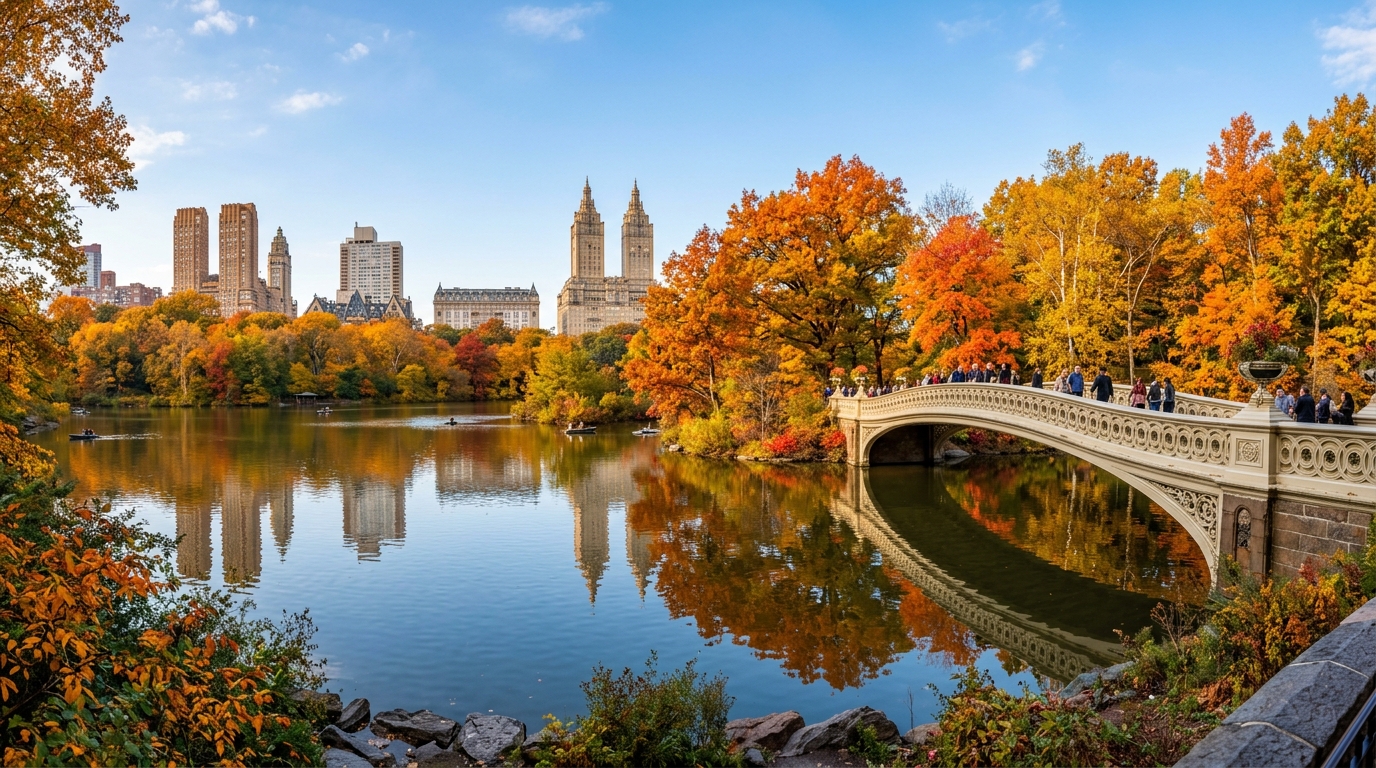
Spanning 60 feet across the neck of The Lake between Cherry Hill and The Ramble, Bow Bridge is the second-oldest cast-iron bridge in America, completed in 1862. Designed by Calvert Vaux with exquisite classical interlocking circles and eight ornate planting urns, the bridge curves gracefully like an archer’s bow. Looking westward from the bridge, the reflective waters of the lake frame the twin pre-war Art Deco spires of The San Remo and The Dakota apartments against the sky. During spring and summer, visitors can rent vintage wooden rowboats from the nearby Loeb Boathouse, drifting lazily beneath weeping willow branches.
5. Strawberry Fields & The Imagine Mosaic
Directly across from the historic Dakota apartment building at 72nd Street and Central Park West lies Strawberry Fields, a 2.5-acre peaceful landscape dedicated to the memory of legendary Beatles musician and peace activist John Lennon. Designated as an international ‘Garden of Peace’ planted with native trees and flowers donated by nations around the world, its focal point is the circular black-and-white Italian marble Imagine mosaic. Created by artisan craftsmen from Naples, Italy, the mosaic serves as a global gathering place where musicians play acoustic guitars and visitors leave fresh flowers in tribute.
The Mid-Park: Rugged Topography, Castles & Cultural Havens
1. The Ramble: A 36-Acre Wilderness in the Center of Manhattan
Immediately north of The Lake lies The Ramble, an intricately choreographed 36-acre wild woodland designed to evoke the rugged Adirondack mountains. Featuring meandering dirt trails, natural rock outcrops, dense hemlock groves, and a babbling artificial stream known as The Gill, the Ramble is internationally renowned as one of the premier birdwatching migratory hotspots in North America. More than 230 avian species, including vibrant warblers, scarlet tanagers, and red-tailed hawks, rest here along the Atlantic Flyway during spring and autumn migrations.
2. Belvedere Castle & Vista Rock
Perched atop Vista Rock—the second-highest natural point in Central Park—Belvedere Castle is a Victorian architectural folly designed in 1869 by Calvert Vaux and Jacob Wrey Mould. Combining Gothic, Romanesque, and Norman stone elements, the miniature fortress features open-air stone balconies and corner turrets that offer panoramic 360-degree vistas across Turtle Pond, the Great Lawn, and the Upper East and Upper West Side skylines. Since 1919, the National Weather Service has officially recorded New York City’s temperatures and wind speeds from the castle’s highest tower.
3. The Great Lawn & Delacorte Theater
Spanning 55 lush acres between 79th and 85th Streets, the Great Lawn occupies the former site of the Croton Lower Reservoir, which was decommissioned and filled with excavated bedrock from Rockefeller Center and subway construction in the 1930s. Today, this sweeping pastoral expanse features eight softball fields and hosts legendary summer concerts by the New York Philharmonic and the Metropolitan Opera. Directly adjacent to Turtle Pond is the Delacorte Theater, the open-air summer home of The Public Theater’s acclaimed, free Shakespeare in the Park productions.
4. The Forgotten Story of Seneca Village
Between 82nd and 89th Streets on the park’s western edge lies the historic site of Seneca Village. Founded in 1825, Seneca Village was Manhattan’s first prominent, thriving community of African-American property owners, later joined by Irish and German immigrants. By 1855, the village boasted three churches, a school, and over fifty homes. In 1857, the City of New York exercised eminent domain to evict the residents and demolish the settlement to clear land for Central Park. Today, historic outdoor interpretive plaques and archaeological excavations commemorate this vital chapter of New York’s cultural history.
| Landmark | Location / Cross Street | Architectural Era | Chauffeur Staging Point |
|---|---|---|---|
| Gapstow Bridge & The Pond | 62nd St near Fifth Ave | Manhattan Schist (1896) | Grand Army Plaza / 59th St |
| Bethesda Terrace & Fountain | 72nd St Center of Park | Neoclassical / Victorian (1873) | 72nd St & Fifth Ave or CPW |
| Bow Bridge & The Lake | 74th St West of Bethesda | Cast-Iron Classical (1862) | 72nd St & Central Park West |
| Belvedere Castle & Vista Rock | 79th St Mid-Park | Victorian Gothic Folly (1869) | 81st St & Central Park West |
| Conservatory Garden | 105th St & Fifth Ave | French, Italian & English (1937) | 105th St Curbside Fifth Ave |
The Northern Park: European Gardens, Quiet Waters & The North Woods
1. The Jacqueline Kennedy Onassis Reservoir
Holding over one billion gallons of water and covering 106 acres between 86th and 96th Streets, the Reservoir is Central Park’s largest body of water. Surrounded by a 1.58-mile crushed gravel running track immortalized in countless films, it offers unobstructed horizon views across the Midtown and Upper West Side skylines. In April, more than thirty Yoshino and Kwanzan cherry blossom trees along the eastern bridle path erupt into clouds of pink and white blossoms.
2. The Conservatory Garden: French, Italian & English Formality
Entered through the magnificent Vanderbilt Gate (wrought iron crafted in Paris in 1894 for the Cornelius Vanderbilt II mansion on Fifth Avenue), the Conservatory Garden is Central Park’s only formal garden. Covering six tranquil acres at 105th Street and Fifth Avenue, this designated quiet zone contains three distinct European garden styles: an Italianate central lawn framed by clipped yew hedges and a 12-foot geyser fountain; a formal French garden showcasing thousands of spring tulips and the historic Three Dancing Maidens fountain by Walter Schott; and an English cottage garden centered around a bronze water-lily pool dedicated to Frances Hodgson Burnett’s literary classic, The Secret Garden.
3. The North Woods, The Ravine & The Loch
Central Park’s northernmost wilderness, The North Woods, is an astonishing 90-acre mountain-forest landscape that feels thousands of miles removed from Manhattan. Fed by municipal water designed to resemble a roaring Adirondack mountain stream, The Ravine flows through a deep gorge of towering oak and beech trees, cascading over five picturesque stone waterfalls before emptying into the Harlem Meer at 110th Street.
Central Park in Cinema: Iconic Movie & Television Landmarks
Few locations in the world are more instantly recognizable on screen than Central Park, having served as the backdrop for more than 350 major motion pictures and television series. Exploring these cinematic touchstones adds a thrilling dimension of nostalgia to any park tour:
- Wollman Rink (Love Story & Serendipity): The sunken ice skating rink nestled against the dramatic backdrop of Central Park South skyscrapers has witnessed some of Hollywood’s most famous romantic moments, from Ali MacGraw and Ryan O’Neal in Love Story to John Cusack and Kate Beckinsale in Serendipity.
- Bethesda Terrace (The Avengers, Elf & John Wick): Bethesda Terrace served as the dramatic concluding assembly point for Earth’s mightiest heroes in The Avengers, where Thor transported Loki back to Asgard using the Tesseract. In Elf, Central Park’s rangers pursued Santa’s sleigh across the terrace bridge. In John Wick: Chapter 2, the iconic fountain plaza is where Winston delivered the fateful ‘excommunicado’ decree.
- The Plaza Hotel & Gapstow Bridge (Home Alone 2): Kevin McCallister’s holiday adventures in Home Alone 2: Lost in New York made Gapstow Bridge and the Pigeon Lady famous worldwide. Stepping onto Gapstow Bridge during winter snowfall feels like walking directly into the classic holiday film.
- Tavern on the Green (Wall Street & Ghostbusters): Originally built in 1870 to house the sheep that grazed the Sheep Meadow, this historic restaurant was transformed into a glittering dining palace in 1934, immortalized in Gordon Gekko’s power lunches in Wall Street and Louis Tully’s encounter with the terror dog in Ghostbusters.
Strategic Touring: Combining Chauffeured Ease with Walking Loops
Because vehicular traffic inside Central Park has been completely banned since 2018 to preserve pedestrian tranquility, exploring the park requires a sophisticated hybrid strategy. A luxury chauffeured tour with Tour to NYC solves the distance challenge effortlessly:
- Curbside Staging at Historic Transverse Gates: Your chauffeur drops your party directly at the closest pedestrian gate (such as 72nd Street for Bow Bridge and Bethesda Terrace), allowing you to enjoy a relaxed 25-minute walking loop without retracing steps.
- Effortless North-South Traversal: Rather than spending two hours walking the two-mile distance between southern Bethesda Terrace and northern Conservatory Garden, your heated or air-conditioned vehicle transfers your group up Fifth Avenue in ten minutes, providing refreshing cold water and charging docks between walks.
- Luggage and Stroller Sanctuary: Families traveling with strollers, mobility aids, or shopping bags from Fifth Avenue stores can leave all belongings securely locked inside the vehicle under the supervision of their bonded chauffeur.
Frequently Asked Questions About Central Park Tours
How long does it take to see the major landmarks of Central Park?
A comprehensive private highlights tour covering the southern, mid-park, and northern gardens takes approximately 3 to 4 hours when utilizing a private vehicle for perimeter transfers between pedestrian walking loops.
Are horse-drawn carriage rides worth it compared to a private tour?
While horse-drawn carriages offer romantic nostalgia, they are legally restricted to a short 20-minute to 45-minute loop in the southernmost section of the park (below 72nd Street) and cannot access The Mall, Bow Bridge, Bethesda Terrace, Belvedere Castle, or the northern gardens. A hybrid chauffeured and guided walking tour covers four times as much ground and provides far deeper architectural insight.
When is the absolute best time of year to visit Central Park?
Central Park is magical in every season. However, mid-to-late October through early November brings world-renowned fall foliage, while mid-April offers peak cherry blossoms and blooming magnolias.
Conclusion: Discover Central Park’s Timeless Wonders
Central Park is the living heart of New York City, where nature and urban majesty achieve perfect harmony. Experience its iconic monuments, secret woodlands, and breathtaking skyline views in supreme elegance and comfort.
Reserve your private Central Park sightseeing experience at Tour to NYC Tours or speak with our concierge team at Tour to NYC Contact today.