Introduction: The Ancient Bedrock Where Modern America Was Forged
Beneath the glittering glass spires of global hedge funds and international investment banks in Lower Manhattan lies the physical, political, and financial cradle of the United States. While Midtown Manhattan dazzles with theatrical marquees and soaring 20th-century Art Deco towers, Lower Manhattan—known universally to New Yorkers as the Financial District or ‘FiDi’—is ancient by American standards. Here, the rigid Cartesian street grid dissolves into a winding, medieval labyrinth of narrow cobblestone lanes that still trace the original 17th-century boundary lines, cattle paths, and wooden palisade walls of Dutch New Amsterdam.
Every square yard of Lower Manhattan resonates with seismic historical milestones: George Washington took the oath of office as the nation’s first President on the open-air balcony of Federal Hall on Wall Street; Alexander Hamilton, the revolutionary architect of American capitalism and the nation’s first Treasury Secretary, rests in peace beneath a granite pyramid in the churchyard of Trinity Church; and the bronze Charging Bull stands as an internationally recognized icon of economic optimism. Yet Lower Manhattan is also a sacred landscape of profound modern resilience, where the shimmering glass parapet of One World Trade Center rises above the solemn, cascading waters of the National September 11 Memorial. Navigating this dense, security-regulated tip of Manhattan on foot or via crowded subway stations can prove daunting. Coordinating your historical pilgrimage with a dedicated private luxury chauffeur from Tour to NYC Tours provides an unparalleled travel advantage: seamless door-to-door transit, curbside drop-offs outside vehicular security checkpoints, and a tranquil climate-controlled mobile sanctuary between historic walking stops.
In this comprehensive historical guide, we chronicle the epic evolution of Lower Manhattan from a Dutch fur-trading outpost to the financial capital of the world, detail essential historic landmarks, explore the contemplative beauty of the World Trade Center campus, and explain how a private chauffeured tour unlocks the timeless legacy of Wall Street.
Dutch Origins: From New Amsterdam’s Palisade to Wall Street
1. Peter Minuit & The 1626 Lenape Island Purchase
The documented European history of Manhattan began in 1624 when the Dutch West India Company established a fortified trading post named New Amsterdam at the island’s southernmost tip. In May 1626, Dutch Director-General Peter Minuit famously negotiated the purchase of Manhattan Island from the local Lenape Native Americans for trade goods valued at 60 Dutch guilders (popularized in folklore as ‘$24 in beads and trinkets’, though in reality consisting of high-value iron kettles, axes, wool blankets, and steel knives). The settlement grew around Fort Amsterdam, situated on the precise site where the monumental Alexander Hamilton U.S. Custom House stands today at Bowling Green.
2. Peter Stuyvesant & The 1653 Wooden Wall
In March 1653, as geopolitical tensions between the Dutch Republic and the British Empire escalated, the imperious Director-General Peter Stuyvesant ordered the construction of a heavy twelve-foot-high defensive palisade made of pointed wooden logs and earthworks spanning twelve city blocks from the East River to the Hudson River. This northern frontier barrier was built to protect New Amsterdam from potential British military invasions and Native American incursions. Running directly along the inner perimeter of this wooden fortification was an unpaved muddy road known to Dutch settlers as ‘Het Cingel’ (The Girdle). When British naval warships seized the city in September 1664 without firing a single shot, renaming the colony New York in honor of the Duke of York, the wooden wall was eventually dismantled for firewood and building timber. Yet the roadway along its alignment retained its descriptive name: Wall Street.
3. Bowling Green: Manhattan’s Oldest Public Park
Designated in 1733 as a public greensward for lawn bowling, Bowling Green is the oldest public park in New York City. In 1770, British authorities erected a monumental two-ton gilded lead equestrian statue of King George III at the park’s center, surrounded by an ornate cast-iron fence. On the evening of July 9, 1776, following the first public reading of the Declaration of Independence to George Washington’s Continental Army troops at nearby City Hall Park, an ecstatic crowd of American patriots and ‘Sons of Liberty’ marched down Broadway, stormed Bowling Green, and violently toppled the royal statue. The lead king was chopped to pieces and shipped by schooner to a foundry in Connecticut, where it was melted down into 42,088 lead musket balls to shoot at British redcoats. The historic 1771 cast-iron fence still surrounds Bowling Green today; visitors can still touch the rough, jagged tops of the fence posts where revolutionary patriots hacked off the royal crown finials with iron chisels.
The Birth of American Governance: Federal Hall & George Washington
1. Inauguration of the First President (April 30, 1789)
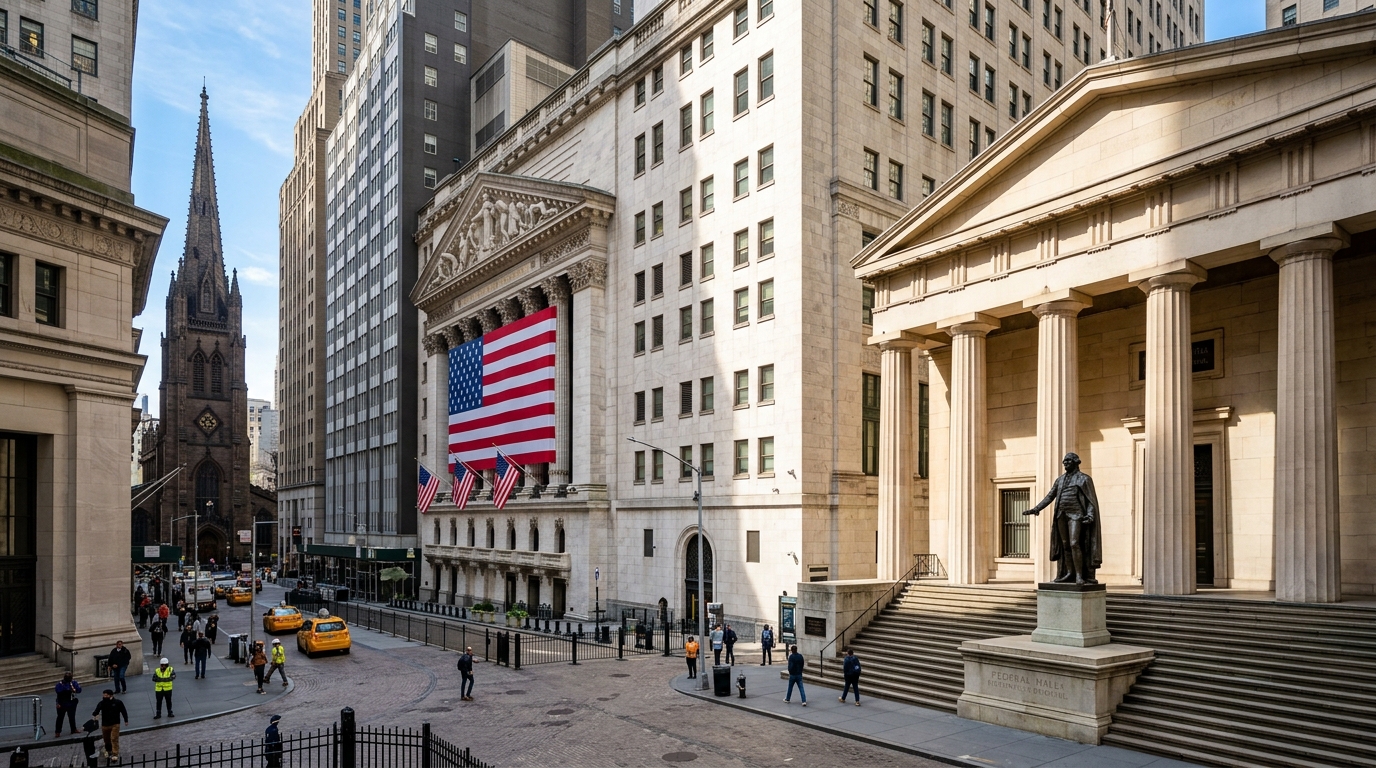
Following the ratification of the United States Constitution, New York City served as the first official capital of the United States from 1785 to 1790. On April 30, 1789, standing on the second-floor open portico of Federal Hall at the intersection of Wall and Nassau Streets, George Washington placed his hand upon a Masonic Bible and took the sacred oath of office as the first President of the United States, administered by Chancellor Robert Livingston. Below the balcony, thousands of cheering citizens filled the cobblestones, tossing their tricorn hats into the air as church bells throughout Manhattan pealed in celebration.
2. The Bill of Rights & The Judiciary Act of 1789
Inside the halls of Federal Hall, the First United States Congress conducted the foundational business of the young American republic. It was here that Representative James Madison drafted and introduced the twelve proposed amendments to the Constitution that became the Bill of Rights (guaranteeing freedom of speech, religion, the press, and assembly). Here also, Congress enacted the Judiciary Act of 1789, establishing the Supreme Court of the United States and creating the federal court system. Although the original 18th-century municipal building was demolished in 1812, the current monumental Greek Revival temple on the site—completed in 1842 as the United States Sub-Treasury—stands as Federal Hall National Memorial. Dominating the grand stone steps is John Quincy Adams Ward’s colossal bronze statue of George Washington, standing on the exact spot where he was inaugurated.
Wall Street & Financial Titans: Alexander Hamilton to J.P. Morgan
1. The Buttonwood Agreement of 1792
On May 17, 1792, twenty-four prominent merchant brokers and auctioneers gathered in the shade of a buttonwood (sycamore) tree outside 68 Wall Street to establish standardized rules and commission structures for trading government bonds and bank shares. The simple two-sentence pact they signed, known as the Buttonwood Agreement, eliminated informal street-curb auctions and gave birth to what would become the New York Stock Exchange (NYSE). Today, the NYSE at 11 Wall Street operates inside an imposing neoclassical palazzo designed by George B. Post in 1903, featuring six massive Corinthian marble columns beneath an ornate pediment entitled ‘Integrity Protecting the Works of Man’.
2. Trinity Church & Alexander Hamilton’s Resting Place
Rising like a gothic sentinel at the western terminus of Wall Street on Broadway, historic Trinity Church has stood as a spiritual landmark since receiving its royal charter from Britain’s King William III in 1697. The current gothic revival brownstone edifice, completed in 1846 by architect Richard Upjohn, features a soaring 281-foot spire that was once the tallest man-made structure in the United States, serving as a beacon for incoming maritime ships entering New York Harbor. In Trinity’s peaceful north and south churchyards lie some of America’s greatest historical figures:
- Alexander Hamilton: The founding father, co-author of The Federalist Papers, and first Secretary of the Treasury rests beneath a prominent white marble obelisk pyramid monument in the south churchyard, having died tragically following his infamous July 11, 1804 duel with Vice President Aaron Burr in Weehawken, New Jersey.
- Elizabeth Schuyler Hamilton: Hamilton’s devoted wife ‘Eliza’, who survived him by fifty years and co-founded New York’s first private orphanage (Graham Windham), rests beside him marked by a simple marble headstone.
- Robert Fulton: Inventor of the first commercially viable commercial steamboat (the Clermont in 1807), buried in the Livingston family vault.
- Albert Gallatin: America’s longest-serving Secretary of the Treasury (serving under Presidents Jefferson and Madison) and founder of New York University.
3. House of Morgan (23 Wall Street)
Directly across from Federal Hall stands 23 Wall Street, the imposing limestone headquarters of J.P. Morgan & Co., erected in 1914. Known simply throughout the global banking world as ‘The Corner’, this four-story fortress was built without any exterior name plaque or signage, signaling that anyone with enough wealth to do business with J. Pierpont Morgan already knew precisely where it was. On September 16, 1920, an unmarked horse-drawn wagon packed with 100 pounds of dynamite and 500 pounds of cast-iron sash weights exploded outside the building during the bustling lunch hour, killing 38 people and injuring hundreds in what was then the deadliest terrorist attack on American soil. Morgan executives refused to repair the building’s exterior limestone facade as an act of defiance; visitors can still inspect the deep shrapnel pits and blasted gouges carved permanently into the granite walls.
| Historic Landmark | Address / Location | Year Founded / Built | Historical Significance |
|---|---|---|---|
| Federal Hall Memorial | 26 Wall Street | 1789 (Rebuilt 1842) | Site of Washington’s Inauguration & Bill of Rights |
| Trinity Church | Broadway & Wall Street | 1697 (Current 1846) | Gothic architectural masterpiece & Hamilton’s grave |
| Fraunces Tavern | 54 Pearl Street | 1762 | Washington’s emotional farewell to Continental Army officers |
| New York Stock Exchange | 11 Wall Street | 1792 (Current 1903) | Epicenter of global capitalism and equity trading |
| Alexander Hamilton Custom House | 1 Bowling Green | 1907 | Beaux-Arts triumph housing National Museum of the American Indian |
Sacred Ground: The National 9/11 Memorial & World Trade Center
1. The Memorial Reflecting Pools (‘Reflecting Absence’)
Covering eight acres of landscaped urban plaza, the National September 11 Memorial honors the 2,977 victims killed in the terrorist attacks of September 11, 2001, as well as the six victims of the February 26, 1993 World Trade Center bombing. Designed by architect Michael Arad and landscape architect Peter Walker, the memorial features two monumental one-acre reflecting pools set within the exact physical footprints where the original Twin Towers once stood. Cascading thirty feet downward into subterranean granite voids, the pools form the largest man-made waterfalls in North America, with 52,000 gallons of recirculating water creating a soothing acoustic barrier that mutes the bustling traffic of Lower Manhattan into peaceful contemplation.
2. The Inscribed Bronze Parapets & Meaningful Adjacencies
Surrounding the perimeter of both pools are heavy bronze parapets inscribed with the names of every victim. Rather than listing names in arbitrary alphabetical order, the memorial team employed a poignant concept known as ‘meaningful adjacencies’: names are grouped together based on where victims were located during the attacks, company affiliations, emergency responder brotherhoods, and personal friendships. On the birthday of each victim, memorial staff place a single fresh white rose inside the engraved letters of their name—a deeply moving daily ritual of remembrance.
3. The Survivor Tree & The Oculus
Standing in the grove of over 400 swamp white oak trees on the plaza is The Survivor Tree—a callery pear tree discovered in October 2001 at Ground Zero, severely scorched, broken, and reduced to a single living branch. Carefully nursed back to health by the NYC Parks Department at a nursery in the Bronx, the tree was replanted on the memorial plaza in 2010. Today, it stands as an international emblem of renewal, hope, and indestructible human spirit. Bordering the eastern edge of the plaza rises The Oculus, Santiago Calatrava’s magnificent $4 billion transit hall and retail pavilion sculpted from white Italian rib steel in the shape of a dove being released from a child’s hands. Every September 11 at 10:28 AM—the precise moment the North Tower collapsed—a retractable skylight along the spine of the Oculus opens, allowing a column of pure sunlight to illuminate the marble floor below in a stunning solar tribute.
Historic Dining on Stone Street: Manhattan’s First Paved Lane
Following a day of profound historical reflection, there is no more atmospheric dining corridor in New York than Stone Street. In 1658, Dutch colonial brewers and residents petitioned the municipal government to pave this narrow lane with round cobblestones to eliminate stagnant horse mud and rain pools, making it the very first paved roadway in New Amsterdam (originally named ‘Brouwers Straat’ or Brewers Street). In 1794, the street was renamed Stone Street in honor of its historic cobblestone paving.
Today, this pedestrianized cobblestone oasis is lined with 19th-century Greek Revival brick loft warehouses converted into bustling oyster houses, craft breweries, and European bistros. During spring, summer, and autumn, hundreds of wooden picnic tables spill onto the historic cobblestones beneath strings of glowing incandescent bulb lights. Iconic culinary stops include:
- The Dubliner: An authentic Irish pub serving draft Guinness, fresh fish and chips, and shepherd’s pie amidst dark mahogany millwork and roaring laughter.
- Adrienne’s Pizzabar: Renowned among Wall Street traders for its signature rectangular ‘Old Fashioned Grandma-style’ pizza—crisp olive-oil-fried crust topped with sweet San Marzano tomato sauce, fresh buffalo mozzarella, and fragrant basil.
- Ulysses’ Folk House: A lively tavern inspired by James Joyce’s literary masterpiece, featuring raw oyster bars, dry-aged steaks, and extensive single-malt whiskey selections.
The VIP Advantage: Exploring Lower Manhattan with a Private Chauffeur
Lower Manhattan presents some of the most complex driving, navigation, and parking challenges on the Eastern seaboard. Following 9/11, extensive security checkpoints, concrete vehicle barriers, and restricted pedestrian-only zones were established around Wall Street, Broad Street, and the World Trade Center campus. Commercial street parking is non-existent, and hailing street taxis during the evening financial rush is notoriously difficult. A private luxury chauffeured vehicle from Tour to NYC Tours transforms your Lower Manhattan sightseeing experience into an effortless, VIP journey:
- Curbside Staging Outside Restricted Security Corridors: Your professional chauffeur knows the exact perimeter staging zones along State Street, West Street, and Water Street. You step out directly at Bowling Green, stroll the historic alleys with a licensed guide, and your vehicle is waiting curbside the instant you emerge.
- All-Weather Luxury & Storage: Lower Manhattan’s proximity to New York Harbor means brisk harbor winds and sudden weather shifts. Retreat into a whisper-quiet, leather-appointed Cadillac Escalade ESV or Mercedes-Benz Sprinter with heated seating, Wi-Fi, chilled beverages, and full luggage storage.
- Effortless Bridges & Tunnel Transfers: When your downtown tour concludes, your chauffeur effortlessly connects to the Brooklyn Bridge, FDR Drive, or West Side Highway, transitioning smoothly to your next borough or evening dinner destination.
Frequently Asked Questions on Lower Manhattan & Wall Street
Is the 9/11 Memorial outdoor plaza free to visit?
Yes. The outdoor 9/11 Memorial plaza, including the twin reflecting waterfall pools and the Survivor Tree, is completely free and open to the public daily from 9:00 AM to 8:00 PM. Admission tickets are required only if you wish to enter the indoor subterranean 9/11 Memorial Museum.
Can visitors go inside the New York Stock Exchange?
No. Following the heightened security protocols established after September 11, 2001, the trading floor of the New York Stock Exchange is permanently closed to public tourist visits. However, visitors can admire and photograph its magnificent neoclassical facade and Corinthian columns from Broad Street outside Federal Hall.
How far is the Battery Park ferry from Wall Street?
Battery Park is just a gentle five to ten-minute walk south of Wall Street along Broadway. Many visitors combine a morning visit to the Statue of Liberty and Ellis Island with an afternoon historical walking tour of Wall Street and the 9/11 Memorial.
Conclusion: Walk the Streets Where a Nation Rose
Lower Manhattan is not merely a modern temple of international trade; it is the physical stage where the American experiment survived its earliest tests and demonstrated its greatest capacity for renewal. Experience the historic majesty of Wall Street, Federal Hall, and the World Trade Center with the unmatched comfort, dignity, and logistical mastery of Tour to NYC.
Book your custom private chauffeured and guided tour at Tour to NYC Tours or consult with our luxury concierge at Tour to NYC Contact today.