Introduction: The Bohemian Heart and Soul of New York City
There is a profound, enchanting geographic and psychological border that occurs when leaving the rigid, rectangular skyscraper grid of Midtown Manhattan and crossing southward beneath 14th Street into Greenwich Village. Suddenly, numbered streets dissolve into winding, irregular lanes with names like Waverly Place, Gay Street, and Minetta Lane. Towering glass-and-steel office monoliths give way to four-story red brick brownstones with wrought-iron balconies, blooming window boxes, gas-lit street lamps, and peaceful leafy courtyards. For more than two centuries, Greenwich Village—and its picturesque western enclave, the West Village—has served as the undisputed cultural sanctuary of American non-conformity, literary genius, social revolution, and artistic rebellion.
From the mid-19th century through the mid-20th century, the Village attracted the world’s greatest creative minds: Edgar Allan Poe penned poetry here; Mark Twain strolled Fifth Avenue; Abstract Expressionist painters Jackson Pollock and Willem de Kooning debated modern art at the Cedar Tavern; Bob Dylan strummed his acoustic guitar in subterranean folk clubs on MacDougal Street; and in 1969, the patrons of the Stonewall Inn on Christopher Street ignited the modern international LGBTQ civil rights movement. Yet exploring the Village’s tangled historical geography can prove bewildering for first-time visitors. Streets bend unpredictably, and historic cobblestones can be uneven. An expertly coordinated private chauffeured tour with Tour to NYC Tours provides the ultimate way to experience this historic district: staging smoothly on wider access avenues while you take intimate guided walking loops through quiet mews, and offering a warm, luxurious haven between historical stops.
In this comprehensive neighborhood guide, we explore the history of Washington Square Park, trace the footsteps of literary giants and musical legends, uncover hidden cobblestone mews, spotlight iconic village bistros, and explain how a private chauffeured tour captures the authentic spirit of the Village.
The Historic Origins: Defying the Commissioners’ Grid Plan of 1811
To understand the charming, idiosyncratic layout of Greenwich Village, one must look back to its early Dutch and colonial origins. In the 1630s, the Dutch West India Company established a tobacco plantation here known as ‘Noortwyck’. Later dubbed ‘Greenwich’ by British colonists in 1696, the area grew as a rural farming hamlet completely independent of the bustling seaport at Lower Manhattan. In 1799, severe yellow fever epidemics swept through crowded Lower Manhattan, prompting thousands of wealthy merchants, bankers, and families to flee northward to Greenwich Village for its fresh country breezes and higher elevation.
When the New York State Legislature adopted the legendary Commissioners’ Plan of 1811—which superimposed the rigid, numbered rectangular grid of 12 avenues and 155 streets across Manhattan—the landowners and residents of Greenwich Village fiercely resisted. Village residents successfully petitioned the city to preserve their existing, organic street patterns that aligned with ancient cow paths, stream beds (like the buried Minetta Creek), and property boundary lines. As a result, the Village stands today as a living architectural museum of early 19th-century urban planning, where West 4th Street miraculously crosses West 10th Street and West 11th Street at right angles.
Historic Landmarks & Cultural Touchstones of the Village
1. Washington Square Park & Stanford White’s Arch
Covering nearly ten leafy acres at the southern foot of Fifth Avenue, Washington Square Park is the grand civic theater of Greenwich Village. Originally a potter’s field and public execution ground in the late 18th century, the park was transformed into a military parade ground in 1826 before evolving into the cultural crossroads of the neighborhood. Anchoring the park’s northern entrance is the monumental Washington Square Arch, designed by celebrated architect Stanford White in 1892 from Tuckahoe marble to commemorate the centennial of George Washington’s presidential inauguration. The central fountain plaza is a buzzing, joyous spectacle of street performers, classical pianists dragging baby grands into the park, folk musicians, and intense chess grandmasters battling on permanent stone tables in the southwest corner.
2. MacDougal Street & The 1960s Folk Music Revolution
Running south from Washington Square Park, MacDougal Street is hallowed ground in American musical history. In the late 1950s and early 1960s, smoky basement coffeehouses along this strip gave birth to the American folk and blues revival:
- The Gaslight Cafe (116 MacDougal Street): Where a nineteen-year-old Bob Dylan first performed ‘Blowin’ in the Wind’ and where Beat poets Allen Ginsberg and Jack Kerouac gave legendary poetry readings to snapping fingers.
- Cafe Wha? (115 MacDougal Street): The legendary basement venue where both Bob Dylan (fresh off the bus from Minnesota in 1961) and Jimi Hendrix (performing as Jimmy James in 1966) were discovered by music producers.
- Caffe Reggio (119 MacDougal Street): Operating continuously since 1927, Caffe Reggio is the birthplace of the American cappuccino, housing the monumental original 1902 chrome-and-bronze espresso machine brought from Italy by founder Domenico Parisi. Admire authentic Renaissance oil paintings and dark woodwork while savoring a rich, foamy cappuccino and cannoli.
3. Stonewall National Monument & Christopher Street
At 53 Christopher Street stands the Stonewall Inn, universally recognized as the birthplace of the modern LGBTQ civil rights movement. In the early morning hours of June 28, 1969, a routine police raid on the underground gay bar was met with spontaneous, defiant protests led by transgender women of color, drag queens, and gay youth, sparking six days of historic demonstrations. Designated as the Stonewall National Monument by President Barack Obama in 2016, the site stands as a triumphant beacon of civil rights, courage, and human equality.
4. The Narrowest House & Literary Haunts (Bedford & Commerce Streets)
Strolling through the West Village reveals astonishing architectural oddities and literary landmarks:
- 75 1/2 Bedford Street (The Narrowest House in NYC): Measuring just nine feet and six inches wide on the exterior and barely six feet wide inside, this charming Dutch-gabled townhouse was built in 1873 in a former carriage alley. Over the decades, it served as the home for Pulitzer Prize-winning poet Edna St. Vincent Millay, anthropologist Margaret Mead, and actor Cary Grant.
- The White Horse Tavern (Hudson & 11th Streets): Operating since 1880, this historic wood-paneled tavern was the favored drinking spot for Welsh poet Dylan Thomas, James Baldwin, Norman Mailer, and Hunter S. Thompson.
- Minetta Tavern (MacDougal Street): Founded in 1937, this legendary Paris-style bistro was frequented by Ernest Hemingway and E.E. Cummings. Reimagined by restaurateur Keith McNally, it remains one of the hardest reservations in New York, famous for its dry-aged ‘Black Label Burger’.
| Village Landmark | Address / Location | Historic Era | Cultural Significance |
|---|---|---|---|
| Washington Square Arch | Foot of Fifth Avenue | Tuckahoe Marble (1892) | Designed by Stanford White for Washington Centennial |
| Caffe Reggio | 119 MacDougal Street | Historic Cafe (1927) | Introduced the cappuccino to the US / 1902 machine |
| The Stonewall Inn | 53 Christopher Street | National Monument (1969) | Birthplace of the modern LGBTQ civil rights movement |
| The Narrowest House | 75 1/2 Bedford Street | Carriage Alley House (1873) | Home of Edna St. Vincent Millay & Cary Grant |
| St. Luke’s in the Fields | 487 Hudson Street | Federal Brick Church (1821) | Serene walled gardens and historic pre-Civil War church |
Hidden Mews & Secret Alleys: Quiet Sanctuaries of the 19th Century
Beyond the main avenues lie secluded ‘mews’—historic cobblestone cul-de-sacs originally constructed in the mid-19th century as private stables and carriage houses for the aristocratic mansions of Washington Square North:
- Washington Mews: Running between Fifth Avenue and University Place just north of the park, this gated cobblestone private street is lined with whitewashed, two-story former stables adorned with climbing ivy, wisteria vines, and blue painted doors, now housing New York University faculty offices and academic institutes.
- MacDougal Alley: Tucked off MacDougal Street, this private alley became a favored haven for renowned 20th-century sculptors, including Gertrude Vanderbilt Whitney, who founded the Whitney Museum of American Art in her studio here in 1931.
- Grove Court: Hidden through a narrow wrought-iron passageway between 10 and 12 Grove Street in the West Village, Grove Court is an enchanting private residential enclave of six federal-style brick townhouses built in 1854 surrounding a verdant gas-lit garden court.
Architectural Forensics: Decoding the Historic Townhouses of Greenwich Village
To wander through the West Village with an educated eye is to read an open-air textbook of American architectural history. Because Greenwich Village was largely spared the mid-20th-century urban renewal bulldozers that demolished much of lower Manhattan, its residential blocks preserve the finest continuous collection of 19th-century domestic architecture in the United States:
- Federal Style (1790–1830s): The oldest surviving homes in the Village—such as the charming twin-windowed residences on Bedford, Commerce, and Morton Streets—are Federal style. Characterized by modest two-and-a-half to three-story profiles, Flemish bond brickwork (alternating header and stretcher bricks for structural strength), high peaked pitched roofs pierced by dormer windows, six-over-six double-hung sash windows, and ornate fanlight transoms framed by delicate leaded glass above wooden entry portals.
- Greek Revival (1830s–1850s): As the young American republic sought ideological inspiration from ancient Athenian democracy, Greek Revival swept New York. The monumental row houses along the north side of Washington Square (numbers 1 through 13, known as ‘The Row’) epitomize this era: soaring four-story facades of deep red brick, solemn fluted marble Greek Doric and Ionic columns flanking high stoops, deeply recessed double doors, and bold Greek-key and palmette fretwork in heavy wrought-iron railings.
- Italianate & Anglo-Italianate (1850s–1870s): During the mid-19th century, wealthy New Yorkers embraced the romantic flair of Renaissance Tuscan villas. Italianate homes feature rich, chocolate-hued brownstone cladding (triassic red sandstone quarried in Portland, Connecticut), dramatic segmental arched windows with heavily carved stone hoods, and enormous overhanging wooden cornices supported by ornate carved brackets and acanthus leaves projecting boldly over the sidewalk.
The Stonewall Uprising & The Birth of the Modern LGBTQ Movement
Greenwich Village’s enduring global legacy is inextricably bound to the struggle for human rights, civil equality, and personal dignity. In the early morning hours of Saturday, June 28, 1969, the course of modern civil rights history shifted forever on Christopher Street:
- The Stonewall Inn Raids: During the 1960s, homosexual acts were actively criminalized across New York State; police regularly raided gay bars, subjecting patrons to public humiliation and arrest. When officers raided the mafia-owned Stonewall Inn at 53 Christopher Street, the crowd—led by brave Black and Latina transgender women, drag queens, and queer youth including Marsha P. Johnson and Sylvia Rivera—refused to disperse. Instead, they took a courageous stand against systemic police harassment, sparking six days of intense civil demonstrations throughout Christopher Park.
- America’s First LGBTQ National Monument: The Stonewall Uprising catalyzed the immediate formation of the Gay Liberation Front and the Gay Activists Alliance, and led directly to the organization of the first Christopher Street Liberation Day March on June 28, 1970—the historic genesis of modern worldwide Pride parades. In 2016, President Barack Obama officially designated the Stonewall National Monument, encompassing the Stonewall Inn and historic Christopher Park, creating the first national park site in American history dedicated to the LGBTQ civil rights movement.
Historic Village Gastronomy: From Hemingway’s Taverns to Legendary Steaks
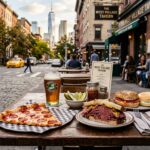
No exploration of the Village is complete without savoring its rich culinary history. Tucked into historic cellar spaces and corner storefronts, several iconic dining institutions continue to define Village nightlife:
- Minetta Tavern (113 MacDougal Street): First established in 1937 and patronized by literary titans Ernest Hemingway, Ezra Pound, E.E. Cummings, and Eugene O’Neill, Minetta Tavern was masterfully resurrected by restaurateur Keith McNally. Known as the ‘Parisian steakhouse of Greenwich Village’, the wood-paneled room is decorated with vintage caricatures, red leather banquettes, and tin ceilings. It is world-famous for its celebrated ‘Black Label Burger’—a proprietary prime dry-aged beef blend crafted by master butcher Pat LaFrieda, smothered in caramelized onions on a brioche bun.
- The White Horse Tavern (Hudson & 11th Street): Operating continuously since 1880, the White Horse is one of New York’s oldest taverns and an essential stop for literary pilgrims. In the 1950s, Welsh poet Dylan Thomas made it his neighborhood pub, famously reciting verse from the mahogany bar. Beat generation icons Jack Kerouac and Allen Ginsberg, alongside rock icons Bob Dylan and Jim Morrison, spent late nights drinking draft ale beneath its pressed tin ceiling.
- Corner Bistro (West 4th & Jane Street): The West Village’s quintessential unpretentious corner pub, operating for nearly a century with a neon McSorley’s sign, dark wooden booths, an antique jukebox, and cash-only counter service serving the legendary ‘Bistro Burger’ on paper plates.
The VIP Advantage: Touring Greenwich Village with a Private Chauffeur
While the narrow, one-way streets of Greenwich Village are famously hostile to standard vehicular traffic and offer virtually zero legal street parking, a private chauffeured luxury vehicle from Tour to NYC provides an exceptional sightseeing advantage:
- Perimeter Access & Doorstep Staging: Your chauffeur drops your party directly at Washington Square Arch, stages along Seventh Avenue South or West Houston Street while you enjoy a guided historical walking loop, and pulls up curbside the instant you are ready to continue.
- Restful Mobile Sanctuary: Step out of busy tourist corridors into a serene, leather-appointed luxury cabin with chilled refreshments, phone charging, and air conditioning before heading to your next historic district.
- Seamless Connections to SoHo & Tribeca: Easily link your Greenwich Village walking tour with luxury shopping in SoHo, dining in Tribeca, or sunset skyline views in DUMBO without waiting for subway transfers or walking through rain.
Frequently Asked Questions on Greenwich Village
What is the difference between Greenwich Village, the West Village, and the East Village?
Historically, Greenwich Village encompasses the entire area from Broadway west to the Hudson River, between Houston Street and 14th Street. The ‘West Village’ refers specifically to the residential area west of Sixth Avenue or Seventh Avenue South, renowned for its quiet cobblestones and luxury brownstones. The ‘East Village’ lies east of Broadway/Bowery, known for its punk rock heritage, immigrant history, and vibrant bohemian nightlife.
Is Greenwich Village safe to explore on foot at night?
Yes. Greenwich Village and the West Village are among the safest, most active, and most densely populated residential neighborhoods in Manhattan, with well-lit streets, bustling sidewalk dining, and lively evening foot traffic.
Can you enter the private mews like Washington Mews and Grove Court?
Washington Mews is generally accessible to respectful pedestrian visitors during daylight hours. Grove Court is private property; however, visitors can admire its picturesque iron gates and historic townhouses from the Grove Street sidewalk.
Conclusion: Fall in Love with the Spirit of the Village
Greenwich Village is an irreplaceable living monument to American creativity, individuality, and architectural romance. Discover its storied past and picturesque streetscapes in supreme comfort and style with Tour to NYC.
Book your custom private walking and chauffeured tour at Tour to NYC Tours or contact our travel planners at Tour to NYC Contact today.