Introduction: Capturing the Most Photographed City in Human History
With its soaring limestone canyons, reflective glass supertalls, historic suspension bridges, and electric neon cross-streets, New York City is universally recognized as the most visually captivating, intensely photographed urban landscape on earth. From the pioneering street photography of Berenice Abbott and Alfred Stieglitz in the early 20th century to the viral golden-hour reels of modern visual creators, Manhattan offers an endless playground of geometry, light, texture, and human drama. Every avenue functions as a natural light funnel; every historic subway entrance frames a human story; and every sunset over the Hudson River bathes millions of windows in molten gold.
Yet capturing world-class, professional-quality imagery in New York requires far more than simply holding up a smartphone or pointing a digital camera. The city is a demanding, high-contrast visual environment: harsh direct shadows can blow out dynamic range; heavy pedestrian foot traffic can crowd your frame; and navigating between geographically distant viewpoints—from sunrise on the Brooklyn waterfront to sunset on the West Side and twilight blue hour in Midtown—can quickly exhaust even the most athletic photographer. Coordinating your photography expedition with a dedicated private luxury chauffeur from Tour to NYC Tours transforms your creative workflow: functioning as your mobile production studio, staging curbside with high-speed battery charging, holding heavy telephoto lenses and tripods securely, and racing across town to beat the setting sun.
In this comprehensive photography master guide, we map New York’s 25 most iconic photo locations, break down optimal lighting hours and focal lengths, uncover secret hidden angles and rooftop perspectives, provide technical shooting tips, and explain how a private chauffeured photo tour captures the definitive visual portrait of New York City.
The Golden Hour Masters: 5 Non-Negotiable NYC Viewpoints
1. Washington Street (DUMBO, Brooklyn) – The Bridge Alignment
Located at the intersection of Washington and Water Streets in DUMBO, this is the quintessential New York architectural alignment. The rugged red-brick warehouse lofts on either side frame the steel anchorage tower of the Manhattan Bridge, while the spire of the Empire State Building sits perfectly framed beneath the lower bridge archway.
- Ideal Lighting: Early morning sunrise (6:30 AM to 8:00 AM) brings warm horizontal side-lighting onto the brick facades with zero crowds. Alternatively, shoot at dusk when the Empire State Building’s architectural tower lights illuminate in the distance.
- Recommended Gear: 50mm to 85mm medium telephoto lens to compress perspective and make the Empire State Building appear larger within the bridge arch. Use aperture f/8 for front-to-back sharpness.
2. Top of the Rock (30 Rockefeller Plaza) – The Empire State Panorama
While the Empire State Building is iconic, the finest observation deck for photographing the Empire State Building is Top of the Rock at Rockefeller Center. Rising 70 stories above Midtown, its open-air, non-glass third-tier observation deck allows photographers to shoot unobstructed without glass reflections.
- Ideal Lighting: Book a timed-entry ticket 45 minutes before sunset. Capture the warm golden rays washing over the limestone tower of the Empire State Building, followed by the 20-minute ‘blue hour’ as the city lights illuminate and Central Park deepens into indigo twilight behind you.
- Recommended Gear: 24-70mm f/2.8 zoom. Note: commercial tripods are strictly prohibited by building security; bring a compact tabletop beanbag pod or shoot handheld with image-stabilized lenses at ISO 800–1600.
3. Tudor City Overpass (42nd Street & Second Avenue) – ‘Manhattanhenge’
Perched on the elevated pedestrian bridge spanning 42nd Street in Tudor City, this viewpoint looks straight west down the commercial canyon of 42nd Street toward Grand Central Terminal, the Chrysler Building, and Times Square.
- Ideal Lighting: Late afternoon sunset, and especially during the biannual astronomical phenomenon known as ‘Manhattanhenge’ (occurring annually around May 28–29 and July 12–13), when the setting sun aligns with mathematical precision along the Manhattan street grid, casting a blinding orb of golden fire straight down 42nd Street.
- Recommended Gear: 70-200mm telephoto lens to compress the layers of yellow taxicabs, city buses, and iconic skyscrapers into a tight, dramatic frame.
4. The Flatiron Building Prow & Madison Square Park
Standing at the southern tip of Madison Square Park (23rd Street and Broadway), Daniel Burnham’s 1902 triangular Beaux-Arts masterpiece resembles a monumental 22-story stone ship plowing through the avenues. Use the manicured flowerbeds, park benches, or yellow cabs on Fifth Avenue as compelling foreground elements.
- Ideal Lighting: Morning light hits the eastern limestone facade; late afternoon golden hour illuminates the sharp six-foot-wide western ‘prow’.
- Recommended Gear: 16-35mm ultra-wide lens to emphasize the soaring vertical wedge, or a tilt-shift perspective control lens to eliminate keystoning distortion.
5. Brooklyn Heights Promenade & Pier 1 (Brooklyn Bridge Park)
Offering the most classic, expansive panoramic view of Lower Manhattan’s financial skyline. From Pier 1’s granite prospect, the wooden pilings of old cargo piers provide dramatic foreground leading lines pointing directly toward One World Trade Center across the harbor.
- Ideal Lighting: Twilight blue hour (20 to 40 minutes after sunset). Long-exposure exposures (5 to 15 seconds) turn the choppy harbor water into a glassy, mirror-like surface reflecting the thousands of glowing office windows.
- Recommended Gear: Wide-angle 24mm lens, solid carbon-fiber tripod, and a 6-stop neutral density (ND) filter for silky water effects.
| Photography Location | Best Time of Day | Recommended Lens | Key Composition Tip |
|---|---|---|---|
| DUMBO Washington Street | Sunrise (6:30 AM – 7:30 AM) | 70-200mm Telephoto | Frame Empire State inside Manhattan Bridge arch |
| Top of the Rock (Observation) | Sunset into Blue Hour | 24-70mm Standard Zoom | Shoot from upper deck with no safety glass panels |
| Tudor City 42nd St Overpass | Late Afternoon / Sunset | 70-200mm Telephoto | Compress traffic canyons and Chrysler spire |
| Central Park Bethesda Terrace | Early Morning (8:00 AM) | 16-35mm Ultra Wide | Capture Minton ceiling tiles and Angel fountain |
| Brooklyn Bridge Park (Pier 1) | Blue Hour (Night) | 24mm Wide Angle | Use long exposure for silky water reflections |
Secret Angles & Architectural Hidden Gems
1. The Woolworth Building Lobby (Broadway & Park Place)
Known as the ‘Cathedral of Commerce’, Cass Gilbert’s 1913 Gothic masterpiece features a lobby adorned with dazzling Byzantine glass-mosaic barrel-vault ceilings, polished marble walls, and whimsical carved caricatures of the architect and founder Frank W. Woolworth counting his nickels and dimes. Photograph with a wide-angle lens pointing upward from the grand marble staircase.
2. The Oculus Skylight Ribs (World Trade Center)
Santiago Calatrava’s white ribbed transportation cathedral looks like an abstract prehistoric skeleton from within. Stand in the center of the subterranean Italian marble floor with a wide-angle lens pointing straight up at the elliptical skylight for a mesmerizing, symmetrical architectural study.
3. The Roosevelt Island Tramway
Board the classic red aerial cable tramway at 59th Street and Second Avenue. As the cabin ascends 250 feet above the East River alongside the historic cantilevered Queensboro Bridge, photograph through the floor-to-ceiling glass windows for breathtaking elevated views down into the traffic flow of First and Second Avenues.
4. Central Park’s Gapstow Bridge & The Plaza
Located at the northeast corner of The Pond near 59th Street, this rustic curved schist stone bridge was built in 1896. Position your camera on the southern bank of The Pond: the curved stone bridge and drooping weeping willows reflect in the still water below, while the opulent limestone towers of The Plaza Hotel and Central Park South rise majestically in the background.
Pro Camera Settings & Technical Field Advice for NYC
New York’s towering vertical geometry and extreme lighting contrasts demand disciplined technical camera mastery:
- Tackling High-Dynamic Range (HDR): Manhattan’s deep skyscraper shadows can be 5 to 7 stops darker than the blazing sky above. Enable auto-exposure bracketing (AEB) on your camera (3 shots at -2, 0, +2 EV) to merge later in Lightroom, ensuring both shadow details in street brickwork and highlights in cloud formations are preserved.
- Handling Street Motion & Long Exposures: To capture iconic light trails from red taillights and yellow taxicabs, switch to Manual mode, set ISO to 100, aperture to f/11 or f/16, and use a 2 to 6-second shutter speed with your camera stabilized on a sturdy tripod or flat ledge.
- Polarizing Filters: Use with Caution: While circular polarizing (CPL) filters are great for eliminating windshield glare and enriching blue skies, be cautious when shooting upward against glass supertalls (like One Vanderbilt or Hudson Yards) at wide angles, as polarizers can create uneven dark cross-hatch bands across tempered architectural glass.
Subway & Transit Architecture: Capturing Historic Underground Geometry
New York’s subterranean transit system is not merely a commuter network; it is a sprawling, century-old underground museum of Beaux-Arts tilework, industrial cast-iron columns, and kinetic motion:
- Grand Central Terminal’s Main Concourse: Standing on the East or West Balcony of Grand Central’s Main Concourse at 42nd Street, position your camera overlooking the vast Tennessee marble floor. Capture the iconic four-faced brass opal clock atop the central information booth (valued at over $20 million) and the 125-foot soaring turquoise celestial ceiling painted by French artist Paul César Helleu with 2,500 gold-leaf zodiac stars. Pro tip: because the ceiling was famously painted backward (astronomically inverted from a celestial perspective), include the grand arched windows in your frame to contrast historic geometry with stream of commuter motion.
- Fulton Center’s Sky Reflector-Net: Designed by Grimshaw Architects and James Carpenter Design Associates, this Lower Manhattan transit hub features an extraordinary integrated artwork: a 53-foot cable net lined with 952 optical aluminum panels that channels natural daylight downward into the deepest subway platforms. Shoot from the lowest mezzanine looking directly upward at wide focal lengths (14mm to 16mm) for an ethereal, geometric spiral composition.
- The 6 Train Ghost Loop (Old City Hall Station): Designed by master architects Heins & LaFarge and opened on October 27, 1904, the abandoned City Hall subway loop is a subterranean jewel box of Gustavino vaulted green and cream tiles, leaded glass skylights, and ornate brass chandeliers. While closed to standard passenger boarding, riders who remain aboard the downtown 6 train as it turns around the loop past Brooklyn Bridge-City Hall can photograph the illuminated station through train windows using fast shutter speeds (1/250s, f/1.8, ISO 3200).
Blue Hour & Night Long Exposure Secrets
When the sun sets, New York transforms into a shimmering sea of neon and tungsten:
- The 20-Minute Blue Hour Sweet Spot: The most critical window for night urban photography occurs precisely 15 to 35 minutes after sunset. At this exact juncture, the residual ambient blue skylight matches the luminous intensity of building interior lights and street lamps, preventing blown-out white windows or pitch-black sky voids.
- Kelvin Color Temperature Calibration: Shooting under mixed city lighting (mercury vapor street lamps, yellow sodium lighting, LED billboards, and tungsten hotel canopies) confuses auto white balance. Manually lock your Kelvin color temperature between 3800K and 4200K to produce crisp, deep cobalt night skies with warm, cinematic golden avenues.
- Star-Filter Aperture Diffraction: Stop your prime or zoom lens down to f/11 or f/16. The physical blades of your lens’s diaphragm will naturally diffract distant pinpoint streetlights and skyscraper spires into clean, multi-pointed starbursts without requiring digital post-processing filters.
The VIP Advantage: The Chauffeur-Driven Photo Expedition
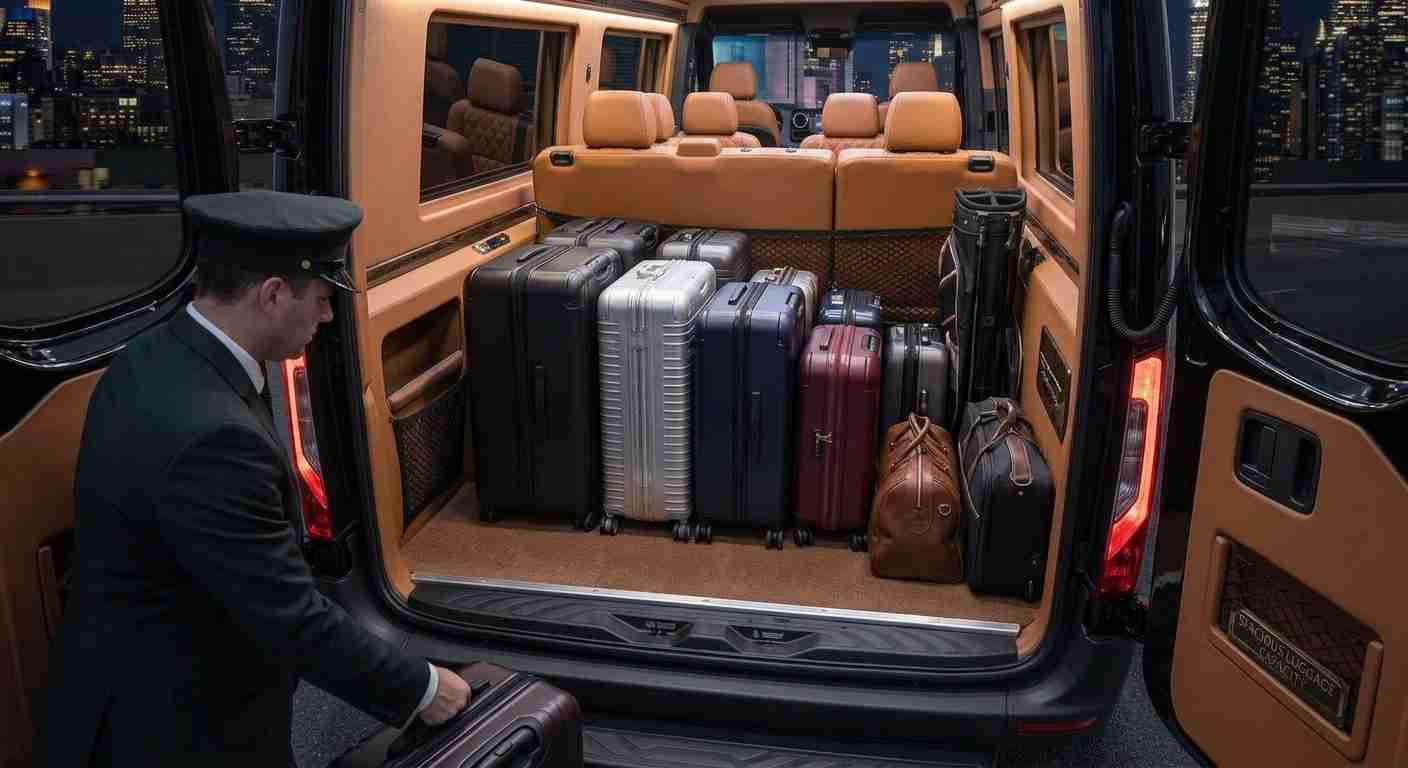
Serious photography in New York is an athletic, gear-intensive pursuit. Hauling two camera bodies, three heavy professional lenses, carbon-fiber tripods, lighting reflectors, and extra batteries across miles of subway platforms and crowded streets is physically punishing and leaves expensive gear vulnerable to theft. A private luxury chauffeured vehicle from Tour to NYC Tours functions as your high-speed mobile production studio:
- Chasing the Light in Real Time: Sunset and golden hour in New York last only twenty precious minutes. While subway commuters are stuck underground, your chauffeur maneuvers swiftly via the FDR Drive or West Side Highway, whisking you from an East River skyline shoot straight to a West Side rooftop in time to catch the dying embers of sunset.
- Mobile Sanctuary & Battery Hub: Keep your high-capacity drone batteries, camera batteries, and laptop editing rigs continuously charged via multiple onboard AC power outlets and USB ports while enjoying plush leather seating and chilled refreshments.
- Secure Gear Fortress: Need to walk into a crowded venue or grab lunch? Leave your heavy Pelican hard cases, backup lenses, and tripods locked safely in the secure cargo hold of your private vehicle under the watchful eye of your professional chauffeur.
Frequently Asked Questions on NYC Photography
Are tripods permitted in New York City public parks and streets?
Yes. Casual personal photography using a tripod is completely legal on public New York City sidewalks and in public parks (including Central Park and Brooklyn Bridge Park) without a permit, provided you do not obstruct pedestrian traffic. However, commercial shoots requiring lighting stands, generators, or staging areas require an official permit from the Mayor’s Office of Media and Entertainment (MOME).
Can you bring professional cameras and lenses onto observation decks?
Yes. Top of the Rock, Edge, One World Observatory, and Summit One Vanderbilt welcome DSLR and mirrorless cameras with telephoto lenses. However, standard tripods, monopods, and professional lighting equipment are prohibited on security grounds.
What is the single best time of year for NYC architectural photography?
October and November are widely considered the premier months. Crisp autumn air provides exceptional atmospheric clarity with zero summer haze, Central Park’s fall foliage turns brilliant shades of gold and amber, and the lower solar angle creates long, dramatic architectural shadows throughout the day.
Conclusion: Create Your Visual Masterpiece with Tour to NYC
Whether you are a seasoned professional photographer building a luxury commercial portfolio or an enthusiastic creator crafting unforgettable social imagery, New York City offers endless inspiration. Maximize your creative output, protect your gear, and capture the city at its most breathtaking angles with Tour to NYC.
Book your custom private photography expedition at Tour to NYC Tours or consult with our creative tour specialists at Tour to NYC Contact today.